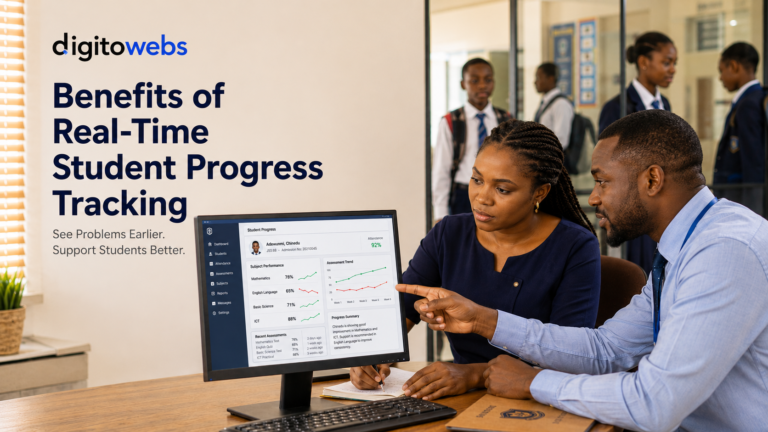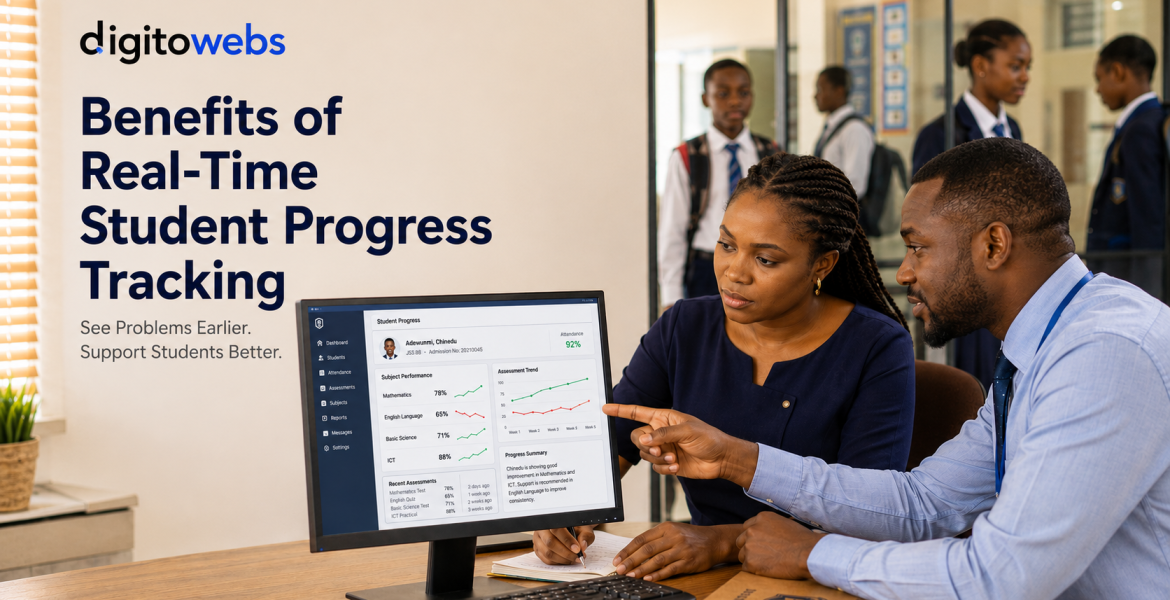
Real-time student progress tracking gives a school something every principal, teacher and parent needs: a clear picture of how each student is doing before it becomes too late to help.
Imagine this situation.
A student begins a new term looking completely fine.
He attends classes. He submits some assignments. He sits quietly during lessons. Nothing seems wrong.
By the middle of the term, however, his Mathematics scores have started dropping.
His class teacher notices one poor test result but assumes it was just a bad day. His parents are busy and have not seen his recent scores. The school administrator has hundreds of students to think about.
Then the examination comes.
The student performs badly.
Suddenly, everyone is concerned.
The parents want to know what happened. The teacher starts going through old records. The school discovers that the warning signs had actually been there for weeks.
The problem was not that the school had no information.
The problem was that the right people did not have the information at the right time.
This is one of the biggest reasons schools are beginning to pay more attention to real-time student progress tracking.
Instead of waiting until the end of a term to discover that something has gone wrong, schools can see progress as learning happens.
And that changes everything.
Table of Contents
ToggleWhat Is Real-Time Student Progress Tracking?
Let us keep this simple.
Real-time student progress tracking means regularly recording and viewing information about a student’s academic journey as it happens.
Instead of keeping important information in different notebooks, spreadsheets, files and teachers’ personal records, a digital system can bring the information together.
Depending on the school’s system, this could include things such as:
- Tests and continuous assessment scores
- Assignments
- Examination results
- Attendance
- Subject performance
- Teacher remarks
- Behaviour or participation records
- Learning milestones
- Overall academic trends
“Real-time” does not necessarily mean that a teacher must enter information every minute.
It simply means that when new information is recorded, authorised people can access the latest available information without waiting for someone to prepare another report manually.
That difference may sound small.
For a school managing hundreds or thousands of students, it can be enormous.
7 Benefits of Real-Time Student Progress Tracking
1. Problems Can Be Identified Before They Become Bigger
This may be the greatest benefit.
Traditional reporting often tells you what happened.
Real-time tracking can help you see what is happening.
Think again about our student struggling with Mathematics.
If his scores looked like this:
72 → 68 → 61 → 54 → 46
there is a story inside those numbers.
The important question is not whether 46 is a poor score.
Everyone can see that.
The important question is:
Why did nobody act when 72 became 68, then 61?
With good student progress records, the teacher can notice a downward pattern earlier.
Perhaps the student does not understand a new topic.
Perhaps he has missed several classes.
Perhaps he stopped submitting assignments.
Perhaps the whole class is struggling with the same concept.
Early information creates an opportunity for early action.
And early action can prevent a poor result from becoming a failed term.
2. Teachers Can Make Better Decisions
Good teachers observe their students every day.
Technology should not replace that.
It should make their observations more useful.
Suppose a teacher has 30 students.
Remembering exactly how every child performed across several tests, assignments and classroom activities can be difficult.
Now multiply that across different subjects and classes.
A digital progress tracking system gives teachers a clearer record to work with.
Instead of saying:
“I think Tunde has been struggling recently.”
the teacher may be able to see that Tunde’s performance has declined across four assessments.
That makes the conversation different.
Teachers can identify students who need extra attention, adjust lessons where necessary and make decisions based on evidence rather than memory alone.
This is one reason real-time student progress tracking can improve the quality of teaching without trying to replace the teacher.
The teacher still makes the decision.
The system simply provides better information.
3. Parents Can Become Partners Instead of End-of-Term Spectators
There is a familiar experience in many homes.
A child brings home a report card.
The parent looks at one subject and asks:
“What happened here?”
Unfortunately, the term is already over.
Whatever happened happened weeks ago.
Now imagine a different relationship.
Instead of learning about serious problems only at the end of the term, parents can receive appropriate progress information during the term.
A parent may see that attendance has dropped.
Another may notice repeated weak performance in English.
Another may see improvement and encourage the child to continue.
This can make parent-teacher conversations more useful because both sides are working with clearer information.
Of course, schools need sensible rules about what parents can see and when they can see it.
Not every internal teacher note should automatically become visible to parents.
Good school technology needs roles, permissions and proper controls.
But when implemented correctly, real-time progress information can turn parents into active partners in a child’s education.
4. Students Can Receive Support That Fits Their Actual Needs
Two students can sit in the same classroom and have completely different problems.
One may understand Mathematics but struggle with English.
Another may perform well in examinations but repeatedly miss assignments.
Another may be improving slowly after a difficult start.
If the school looks only at the final average, some of these differences can disappear.
Progress tracking gives teachers a more complete picture.
This makes targeted support easier.
A student struggling with one subject may receive extra help in that subject rather than being treated as a generally weak student.
A high-performing student who suddenly begins declining can also receive attention before the problem becomes serious.
That is important because good education is not simply about recording scores.
It is about using information to help children learn.
5. School Leaders Get a Better View of What Is Happening
A principal should not have to wait until the end of the term to understand the academic health of the school.
With properly structured data, management can begin asking better questions.
Which classes are improving?
Which subjects appear to be difficult across several classes?
Are particular students consistently falling behind?
Are assessments being entered on time?
Is there an attendance pattern that deserves attention?
Are interventions actually producing improvements?
The value here is not simply having a colourful dashboard.
The value is better decision-making.
A dashboard filled with numbers that nobody acts on is just decoration.
A good school management system should turn information into something school leaders can understand and use.
This becomes increasingly important as a school grows.
What a proprietor can personally monitor with 50 students becomes much harder with 500 or 1,500 students.
Digital systems help the school’s processes grow with the school.
6. Real-Time Student Progress Tracking Can Reduce Administrative Stress
Consider how many people may become involved when records are mostly manual.
A teacher records scores.
Someone collects the scores.
Another person enters them into a spreadsheet.
Someone checks the spreadsheet.
Reports are prepared.
Corrections are requested.
Another version is created.
Parents ask questions.
Staff search through records again.
This creates work.
It also creates opportunities for mistakes.
A properly designed digital workflow can reduce unnecessary duplication.
A teacher records authorised information once.
The system stores it.
The appropriate calculations can be performed consistently.
Authorised users see the information relevant to them.
Management can access reports without asking someone to recreate the same information every time.
This does not mean administration disappears.
It means staff can spend less time moving information around and more time actually using it.
For a growing Nigerian school, that can become a major operational advantage.
7. Schools Can Build Greater Trust With Parents
Parents are not only paying school fees.
They are trusting a school with something far more valuable: their children.
Communication matters.
A school that provides clear, organised and timely academic information can feel more accountable than one where parents repeatedly have to call the office to ask basic questions.
Digital progress tracking can become part of that experience.
The school’s professional website, parent portal and school management system can work together to create a stronger digital relationship between the school and its families.
That experience says:
“We know what is happening, we keep proper records, and we take communication seriously.”
That can strengthen confidence in the school.
What Should a School Track?
The answer depends on the school.
More data is not automatically better.
Schools should track information that helps teachers, parents or management make useful decisions.
For many schools, this may include academic scores, attendance, assignments, subject performance and teacher remarks.
Other schools may need more detailed information.
The key is to avoid collecting information simply because software makes it possible.
Every important piece of data should answer a question.
Who needs this information?
Why do they need it?
What should they be able to do after seeing it?
That is the difference between useful school technology and technology that simply creates more work.
How Real-Time Student Progress Tracking Helps Teachers
Teachers are often the people most affected by a poorly planned school system.
If software makes teachers enter the same information three times, the software has not solved the problem.
It has created another one.
A good system should make common tasks easier.
Teachers should be able to record relevant academic information without fighting complicated screens.
They should be able to find their classes, students and assessments quickly.
And permissions should ensure they only have access to information appropriate to their roles.
Technology succeeds in a school when teachers can actually use it during normal school life.
Not just during a software demonstration.
How Real-Time Tracking Helps Parents
Parents usually do not need every piece of information stored by a school.
They need the right information presented clearly.
A well-designed parent experience might help a parent understand:
- How the child is performing
- Recent results
- Attendance information
- Areas requiring attention
- Published reports
- Relevant school communication
This is also why mobile-friendly design matters greatly.
Many Nigerian parents will access school information from a smartphone rather than sitting behind a desktop computer.
A parent portal that technically works but is painful to use on a phone has only solved half the problem.
How Real-Time Tracking Helps School Management
For management, the biggest benefit is visibility.
A school owner or principal can move from asking:
“How do you think the students are doing?”
to asking:
“What is the information showing us?”
That does not remove professional judgement.
It improves it.
Management can use trends to guide meetings, academic interventions and planning.
And as historical information builds over time, the school can compare performance across terms and sessions rather than relying only on memory.
The Cost of Not Tracking Student Progress Properly
Sometimes the easiest way to understand the value of a system is to look at the cost of doing nothing.
A school may continue using paper, scattered spreadsheets and disconnected WhatsApp messages because that is how things have always been done.
There may be no obvious crisis today.
But problems accumulate quietly.
Records become harder to retrieve.
Teachers leave with knowledge that was never properly documented.
Parents receive information too late.
Management struggles to see patterns.
Administrative work increases as the number of students grows.
And important learning problems may remain hidden until examinations expose them.
The danger is not that paper is automatically bad.
The danger is building a growing school around processes that cannot grow comfortably with it.
Choosing the Right Digital Solution for Your School
This is where schools should be careful.
Digitisation is not simply about buying software.
The wrong system can create a different set of problems.
A school may end up paying for features it never uses, forcing teachers through complicated workflows or operating a website, result portal and management system that do not work well together.
Before choosing a solution, ask practical questions.
Will teachers actually use it?
Does it work properly on mobile devices?
Can permissions be controlled?
Can parents easily understand their side of the system?
Can it grow as student numbers increase?
Who provides support when something goes wrong?
And who is responsible for the hosting, domain, updates, backups and ongoing website management?
That last question is often forgotten.
A school does not only need something that works on launch day.
It needs something that keeps working.
Your School Website Should Be Part of the Bigger Picture
Your public website is often where the relationship starts.
A parent hears about your school and searches online.
They visit your website.
They learn about your school, academics and admission process.
They make an enquiry.
Later, if they become a parent, their digital relationship with the school may continue through other authorised systems.
That is why schools should avoid treating their website as an isolated online brochure.
It should form part of a thoughtful digital experience.
For schools that need a professional online presence without wanting to manage all the technical work themselves, explore the DIGITO WEBS Fully Managed Website Plans on the DIGITO WEBS website.
A fully managed approach means you are not simply paying somebody to design pages and disappear.
Your website can be handled together with essential needs such as domain, hosting, ongoing website management and support, depending on the plan and agreed scope.
That matters because school administrators should be spending their time running the school — not troubleshooting website hosting.
Real-Time Student Progress Tracking Is About Earlier Action
After all the dashboards, reports and technology, this is the part worth remembering.
Go back to the student we met at the beginning.
His Mathematics score did not suddenly become poor on examination day.
The decline happened gradually.
The information existed.
What was missing was visibility at the right time.
That is the real promise of real-time student progress tracking.
It can help schools move from:
“We discovered the problem.”
to:
“We noticed the problem early enough to do something about it.”
And when the subject is a child’s education, that difference matters.
Frequently Asked Questions About Real-Time Student Progress Tracking
What is real-time student progress tracking?
Real-time student progress tracking is the use of regularly updated records to help authorised teachers, administrators and, where appropriate, parents understand how a student is progressing without waiting until the end of a term.
What are the main benefits of real-time student progress tracking?
The major benefits include earlier identification of learning problems, better teacher decisions, improved parent communication, easier administration, stronger school oversight and more targeted student support.
Can student progress tracking improve academic performance?
Tracking alone does not improve results. The benefit comes when teachers and school leaders use the information to identify problems, provide support and make better academic decisions.
Is real-time progress tracking useful for small schools?
Yes. A smaller school can benefit from organised records and better parent communication. It can also establish good digital processes before student numbers grow.
Should parents have access to all student records?
Not necessarily. Schools should decide which information parents, teachers, students and administrators can access. A good system should provide role-based permissions and protect sensitive information.
Can a school website include a student or parent portal?
Yes, although the exact architecture depends on what the school needs. A public school website, parent/student access and a full school management system serve different purposes and should be planned properly.
Does a school still need a professional website if it has a school management system?
Yes. The public website serves prospective parents, students and the wider public, while a management system handles authorised internal processes. The two can complement each other.
How much does a fully managed school website cost in Nigeria?
Pricing depends on the number of pages, required functions, integrations and the level of ongoing management required. A fully managed website should also be evaluated based on what is included beyond design, such as hosting, domain, maintenance and support.
Let DIGITO WEBS Manage Your School’s Website
Your school should not have to become a technology company just to maintain a professional online presence.
With a DIGITO WEBS Fully Managed Website, we take care of the technical side so your team can focus on education.
From the website itself to hosting, domain, ongoing website management and support, the goal is to give your school a professional digital presence without adding another technical burden to your administration.
If your current school website is outdated, difficult to manage, poorly designed for mobile users or simply not representing the standard of your school anymore, doing nothing also has a cost.
Every parent who searches for your school is forming an impression.
Make sure it is the right one.
Get Started with DIGITO WEBS: Call or WhatsApp +234 706 771 9042, email support@digitowebs.com, or visit DIGITO WEBS to explore our Fully Managed Website Plans and choose the right option for your school.