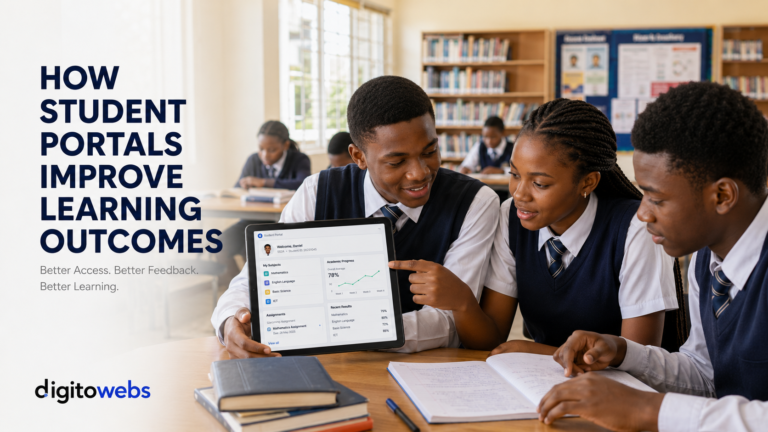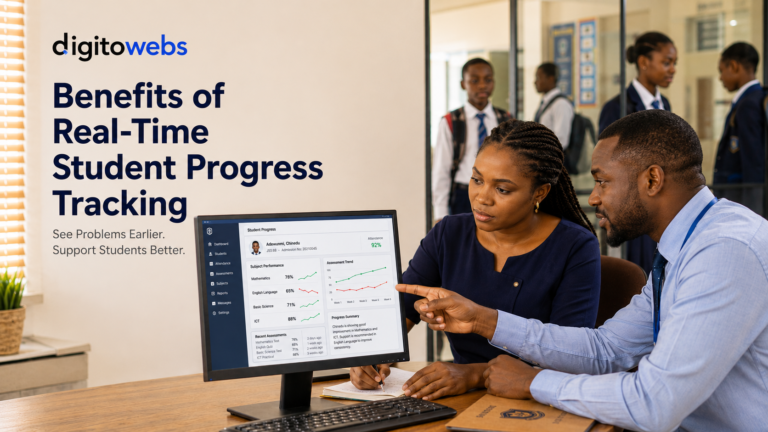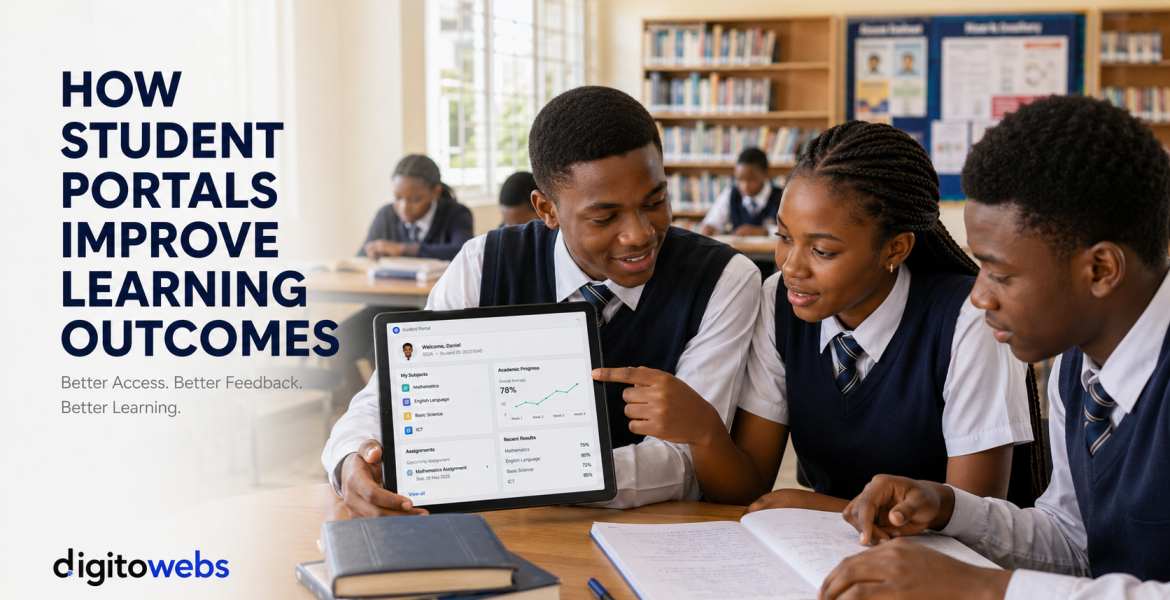
How student portals improve learning outcomes becomes easier to understand when you imagine a student trying to prepare for an important test on a Sunday evening.
She remembers that her teacher gave the class some revision materials during the week.
But there is a problem.
She cannot find them.
Maybe they were sent to a WhatsApp group filled with hundreds of messages. Perhaps the document is sitting inside her parent’s phone. Maybe she forgot the printed copy at school.
She sends a message to a classmate.
No response.
She searches through old WhatsApp messages.
Still nothing.
Eventually, she gives up.
Now imagine another student in the same situation.
He opens his school’s student portal.
He logs in.
There are his subjects.
There are his recent results.
There is the learning material uploaded by his teacher.
There is the assignment he needs to complete.
Within a few minutes, he is studying.
The difference between these two students is not intelligence.
It is access.
And that simple difference helps us understand why a well-designed student portal can become much more than another piece of school technology.
When properly implemented, it can become part of the learning experience itself.
Table of Contents
ToggleWhat Is a Student Portal?
Let us remove all the technical language.
A student portal is simply a secure online space where a student can log in and access information and services provided by the school.
Think of it as the student’s personal digital school desk.
Depending on the school and the system being used, a student may be able to see:
- Subjects
- Class information
- Assignments
- Continuous assessment scores
- Examination results
- Teacher feedback
- Attendance information
- Learning materials
- School announcements
- Academic calendar
- Timetables
- Fees or payment information
- Personal academic progress
The exact features will differ from one school to another.
And that is important.
A good student portal should not contain features simply because they look impressive during a demonstration.
Every feature should solve a real problem.
The real question should always be:
How does this make school easier, clearer or more useful for the student?
Why Student Portals Matter for Modern Schools
Schools have always managed information.
The difference today is the amount of information being managed and how quickly people expect to access it.
Students have assignments.
Teachers have scores.
Administrators have records.
Parents want updates.
Management needs reports.
Without a connected system, information can easily become scattered across paper files, notebooks, spreadsheets, emails and WhatsApp conversations.
That may work when a school is very small.
As the school grows, the cracks begin to show.
Someone cannot find a result.
A parent did not receive an announcement.
A student lost an assignment sheet.
A teacher needs an old academic record.
An administrator has to search through several files.
A student portal can create a clearer connection between the student and the school’s academic information.
But its value goes beyond convenience.
Used properly, it can support better learning.
7 Ways Student Portals Improve Learning Outcomes
1. Students Get Easier Access to Learning Materials
Learning does not stop when the school bell rings.
A student may want to revise at home.
Another may need to complete an assignment during the weekend.
Another may have missed school because of illness.
If learning resources are only available physically inside the classroom, access becomes limited.
A student portal can provide a central place for authorised learning materials.
A teacher could make available:
- Revision notes
- Worksheets
- Assignment instructions
- Recommended reading
- Study guides
- Practice questions
- Class resources
Students know where to look.
This sounds simple, but simplicity matters.
Every unnecessary barrier between a student and learning makes studying harder.
A good portal removes some of those barriers.
2. Students Can Understand Their Academic Progress Better
Imagine receiving this information:
Mathematics: 64%
Useful?
Yes.
But now imagine seeing:
Test 1: 48%
Test 2: 55%
Assignment: 62%
Test 3: 68%
Current progress: Improving
The second view tells a story.
The student can see movement.
That can be powerful.
One student may realise:
“I am actually getting better.”
Another may realise:
“My performance has been falling. I need help.”
When students can understand their academic progress, learning becomes less mysterious.
Results stop being something that suddenly appears at the end of the term.
Instead, performance can become something students actively follow.
This is one important example of how student portals improve learning outcomes: they can make progress more visible.
3. Teacher Feedback Becomes Easier to Access
A score tells a student what happened.
Good feedback can help explain what to do next.
Imagine a student receives 52% in Basic Science.
Without feedback, the student simply knows the score.
But suppose the teacher adds:
“Good understanding of the first section. Revise energy conversion and practise questions 4–8 again.”
Now the student has direction.
When appropriate feedback is available through a portal, students can return to it instead of trying to remember everything the teacher said during class.
This does not replace face-to-face teaching.
It supports it.
The classroom conversation happens once.
Digital feedback can remain available for reference.
That is particularly useful for students who need more time to understand something.
4. Student Portals Can Encourage Greater Responsibility
There is a major difference between:
“My teacher has my results.”
and:
“I can see my results and understand where I need to improve.”
The second encourages ownership.
A well-designed portal can help students become more aware of:
- Upcoming assignments
- Missed work
- Recent results
- Attendance
- Academic targets
- Learning resources
Of course, technology will not suddenly make every student disciplined.
A portal is a tool, not magic.
But giving students clear access to their academic responsibilities makes it easier for schools to encourage independence.
Over time, students can learn to check what needs to be done instead of always waiting to be reminded.
That is an important life skill beyond the classroom.
5. Students Can Identify Weak Subjects Earlier
Consider two students.
Student A gets:
- Mathematics: 76%
- English: 72%
- ICT: 81%
- Basic Science: 49%
Student B gets:
- Mathematics: 58%
- English: 60%
- ICT: 61%
- Basic Science: 59%
Their overall averages may not immediately tell the full story.
Student A has a specific problem.
Basic Science needs attention.
Student B may need more general academic support.
When subject performance is clearly presented, students and teachers can understand these differences more easily.
That allows support to become more targeted.
Instead of saying:
“You need to study harder.”
the conversation can become:
“Your other subjects are going well, but we need to work on Basic Science.”
Specific problems are easier to solve than vague ones.
6. Learning Can Continue Beyond the Classroom
A modern school should not necessarily become an online school.
There is enormous value in physical classrooms, teachers, classmates and direct interaction.
But digital systems can extend learning beyond the classroom.
Imagine a student gets home and remembers something from Mathematics class but cannot completely understand it.
If the teacher has made the relevant material available through the portal, the student can revisit it.
A student who missed school may be able to see what needs attention.
A student preparing for an examination can find resources without waiting until the next school day.
The portal becomes a bridge between:
school → home → school.
That continuity can support stronger learning habits.
7. Better Communication Can Reduce Confusion
Sometimes poor academic performance has nothing to do with intelligence.
A student misunderstood the assignment deadline.
Another did not know a test was coming.
Another lost the worksheet.
Another parent did not receive important information.
Communication problems create learning problems.
A properly designed portal can provide one reliable place for relevant academic information.
That does not mean schools should stop speaking to students or parents.
It means important information has a home.
When everybody knows where to check, there is less dependence on:
“I thought someone told you.”
And less confusion means students can focus more on learning.
What Should a Good Student Portal Include?
This is where schools should resist the temptation to simply buy the system with the longest feature list.
More features do not automatically create a better student portal.
A good portal should be simple enough for students to actually use.
Depending on the school, useful features may include:
- Personal dashboard
- Subject information
- Assessment results
- Examination results
- Academic progress
- Assignments
- Teacher feedback
- Learning materials
- Attendance
- Timetable
- School announcements
- Academic calendar
Older students may need different features from younger students.
A nursery or primary school may rely much more heavily on the parent portal.
A secondary school may give students more direct access.
The system should fit the school’s actual structure.
Technology should adapt to the school — not force the school to become something it is not.
How Student Portals Help Teachers
A student portal is not only for students.
The information students see usually begins with teachers.
This means the teacher experience matters enormously.
If teachers need 20 clicks to record a simple assessment, the portal will eventually become a burden.
A good school system should make it easy for authorised teachers to manage the information connected to their classes.
This may include entering scores, publishing assignments, adding feedback or providing learning resources.
The objective should be to reduce unnecessary work.
A teacher should not enter the same score into a notebook, then a spreadsheet, then another portal.
That is not digital transformation.
That is digital duplication.
The best systems create a clear workflow in which information is entered appropriately and then becomes available to the people who are authorised to see it.
How Student Portals Help Parents
Parents naturally want to know how their children are doing.
But parents should not have to wait until the end of the term before discovering a serious problem.
Where the school’s policies allow it, a parent portal connected to the same academic system can provide appropriate visibility.
A parent may be able to see:
- Academic performance
- Published results
- Attendance
- School announcements
- Relevant teacher comments
- Fees or payment information
This creates better conversations at home.
Instead of:
“How was school?”
and receiving:
“Fine.”
a parent may be able to ask:
“I noticed your Mathematics result improved this week. What changed?”
That is a very different conversation.
Student Portals Can Give School Management Better Visibility
A school owner or principal cannot personally follow every student.
As enrolment increases, that becomes impossible.
Digital records can give management a broader view.
For example, school leaders may be able to identify:
- Classes with unusual performance patterns
- Subjects where many students are struggling
- Attendance concerns
- Missing academic records
- Improvement across terms
- Students requiring intervention
This is where a portal becomes part of something bigger.
It is not just a login page.
It becomes part of the school’s information system.
And better information can lead to better decisions.
Why Mobile Access Matters for Schools in Nigeria
A beautiful student portal that only works properly on a laptop is not enough.
Students and parents increasingly interact with digital services from smartphones.
For many families, the phone is the main internet device.
That means important functions should be designed with smaller screens in mind.
Buttons should be easy to tap.
Text should be readable.
Menus should be simple.
Results should not require endless horizontal scrolling.
Pages should not be unnecessarily heavy.
This is particularly important in Nigeria, where data usage, internet quality and device differences can affect the experience.
Good digital design should consider the environment in which people will actually use the system.
Not just how beautiful it looks on the developer’s large monitor.
The Cost of Running a School Without Connected Digital Systems
There is always a cost to introducing technology.
But there is also a cost to doing nothing.
That second cost is easier to ignore.
Imagine a growing school continuing to manage important information across:
- Paper files
- Teachers’ notebooks
- Multiple spreadsheets
- WhatsApp groups
- Personal phones
- Printed report sheets
It may continue working.
Until it doesn’t.
As student numbers increase, administrative pressure increases too.
Finding old information takes longer.
Mistakes become harder to trace.
Parents expect faster communication.
Teachers repeat work.
Management struggles to see the full picture.
And when an experienced employee leaves, some important knowledge may leave with them.
The question is therefore not simply:
“How much will a student portal cost?”
A better question is:
“What is our current way of working already costing us?”
Time has a cost.
Errors have a cost.
Poor parent experience has a cost.
Slow access to academic information has a cost.
And choosing the wrong digital solution can also be expensive.
Choosing the Right Student Portal for Your School
Do not choose a student portal simply because somebody showed you a beautiful dashboard.
Ask practical questions.
Can our teachers use it easily?
Does it work well on phones?
Can different users have different permissions?
Can it grow with our student population?
How is student information protected?
What happens when we need support?
Can it work properly with the rest of our school’s digital systems?
Who handles updates and maintenance?
The best technology is often the technology that quietly becomes part of normal school life.
People should not spend every week fighting the system.
Your School Website and Student Portal Should Work Together
There is another mistake schools sometimes make.
They build a public website from one provider.
Then they get a result portal somewhere else.
Another company handles hosting.
Someone else controls the domain.
Another system manages students.
Eventually, nobody is completely sure who is responsible for what.
Your public website and your internal school systems serve different purposes, but they should be planned as parts of the same digital journey.
A prospective parent may begin on your website.
They learn about the school.
They read about academics.
They check admission information.
They make an enquiry.
Their child eventually enrols.
Now the family’s relationship with the school continues through authorised digital systems such as parent and student portals.
That journey should feel organised.
And it begins with having the right digital foundation.
A Fully Managed School Website Can Remove the Technical Burden
A school should not need an in-house web developer simply to keep its website running properly.
This is where a Fully Managed Website can make sense.
Instead of paying someone to design a website and then leaving your school to handle everything afterwards, the website can be managed as an ongoing service.
At DIGITO WEBS, our Fully Managed Website approach is designed to remove much of that burden.
Depending on your selected plan and agreed requirements, your school’s digital presence can be supported with essentials such as:
- Professional website design
- Domain
- Hosting
- Ongoing website management
- Technical support
- Website updates and maintenance
That means your administrator does not need to become a hosting expert.
Your principal does not need to understand WordPress updates.
And your school should not have to start searching for a random developer every time something needs attention.
You focus on running the school.
The technical side is professionally managed.
How Student Portals Improve Learning Outcomes: The Bigger Lesson
Remember the student from the beginning?
She wanted to study.
The problem was not motivation.
The information she needed was simply difficult to find.
That is an important lesson.
Technology does not improve education simply because a school has technology.
It improves education when it removes barriers.
A good student portal can remove barriers between students and learning resources.
Between students and their results.
Between teachers and useful academic information.
Between parents and their children’s progress.
Between management and the information needed to make decisions.
And when those connections become easier, the school creates a better environment for learning.
That is ultimately how student portals improve learning outcomes.
Not through fancy dashboards.
Through better access, better communication, better information and earlier action.
Frequently Asked Questions
What is a student portal?
A student portal is a secure digital platform where students can access authorised school information such as results, assignments, learning resources, timetables, announcements and academic progress.
How do student portals improve learning outcomes?
Student portals can improve learning outcomes by making learning resources easier to access, showing students their academic progress, improving feedback, reducing communication gaps and helping students take greater responsibility for their learning.
Can a student portal replace teachers?
No.
A student portal is a tool that supports teachers and students. Good education still depends heavily on teachers, classroom interaction, school leadership and student effort.
Can parents also access the student portal?
Schools commonly provide separate parent access or a parent portal. What parents can see should depend on the school’s policies and user permissions.
Is a student portal useful for primary schools?
Yes, although younger students may not use the portal independently as much as secondary-school students. For younger pupils, parent access can play a larger role.
Should a student portal work on mobile phones?
Yes. Mobile accessibility is particularly important for Nigerian schools because many students and parents access online services mainly through smartphones.
Can a school website and student portal work together?
Yes. The public website can serve prospective families and the general public, while secure portals serve existing students, parents, teachers and administrators.
Does every school need a complicated student portal?
No.
Schools should choose technology based on their actual needs. A simple system that staff and students consistently use can be more valuable than a complicated platform filled with unused features.
How much does a school website cost in Nigeria?
Website pricing depends on the number of pages, features, integrations and level of management required. Schools should also consider whether the price includes important ongoing costs such as the domain, hosting, website management and support rather than comparing design prices alone.
Can DIGITO WEBS build and manage our school website?
Yes. DIGITO WEBS provides Fully Managed Website solutions designed to give organisations a professional online presence while reducing the technical work involved in hosting, domain management, updates and ongoing support.
Give Your School a Better Digital Experience With DIGITO WEBS
Your school’s digital experience says something about the school itself.
When parents visit your website, can they easily understand what makes your school different?
Can they find admission information?
Does the website work properly on their phones?
Does it look like the quality of school you are asking them to trust with their children?
And after students enrol, are your digital processes helping or frustrating the people who use them?
Choosing the wrong solution can leave your school paying for disconnected systems, chasing developers and managing technical problems that have nothing to do with education.
Doing nothing has a cost too.
An outdated website can quietly create the wrong first impression every day.
DIGITO WEBS can help you build a professional, modern and properly managed online presence without adding another technical headache to your school.
With our Fully Managed Website Plans, you can have the website itself together with the ongoing support needed to keep it working — including hosting, domain, website management and technical support, according to your selected plan and agreed scope.
Ready to improve your school’s online presence?
Choose a Fully Managed Website Plan and let DIGITO WEBS handle the technical work.
Call / WhatsApp: +234 706 771 9042
Email: support@digitowebs.com
Website: www.digitowebs.com
CTA: Get Started → Choose a Fully Managed Website Plan