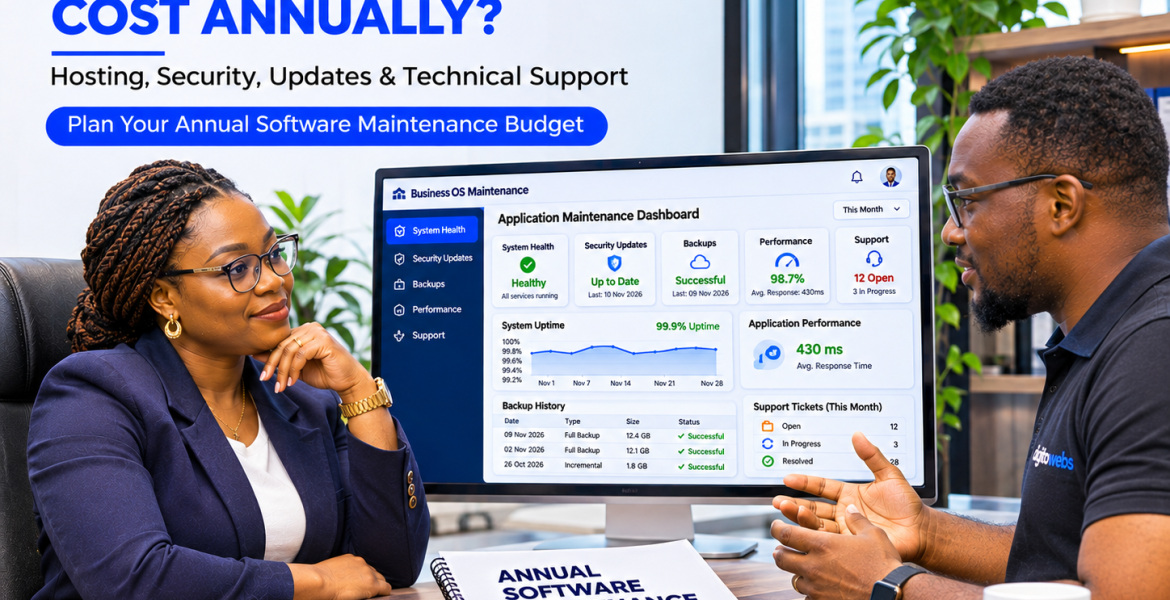
Custom software maintenance cost in Nigeria depends on the size and complexity of the application, hosting infrastructure, security requirements, support expectations, number of integrations and the level of ongoing technical work required.
As a general budgeting guideline, businesses sometimes allocate approximately 15% to 25% of their original software development cost annually for ongoing maintenance and support.
However, this is only a planning heuristic, not a universal industry standard or a fixed DIGITO WEBS maintenance rate.
Some applications may require less, while complex enterprise platforms, heavily integrated systems and applications requiring continuous development may cost significantly more to maintain.
For example, if a business invests ₦5 million in custom software development, a preliminary maintenance planning allowance of 15% to 25% would represent approximately ₦750,000 to ₦1,250,000 annually.
If the application costs ₦20 million to develop, the same calculation would produce an annual allowance of ₦3 million to ₦5 million.
These amounts are illustrative. Actual maintenance fees must be determined by the application’s technical requirements, infrastructure, support obligations and service-level agreement.
At DIGITO WEBS, custom software development starts from ₦1,200,000, while ongoing software maintenance and technical support are scoped and quoted according to the application’s requirements.
But why does software need maintenance after development?
And what exactly are businesses paying for every year?
Imagine you own a distribution company in Lagos.
Your business recently invested in a custom ERP system that connects sales, inventory, procurement, accounting and management reporting.
The software is working well.
Your employees can process orders, monitor stock, generate invoices and access reports.
You have successfully moved away from disconnected spreadsheets.
However, several months after deployment, your business begins to experience new requirements.
A payment provider changes part of its integration.
Your company opens another branch.
An operating system or software dependency requires a security update.
Employees report a few issues that need correction.
Your database grows as more transactions are recorded.
Management requests an additional report.
These are normal operational realities.
A business application is not something that should simply be developed, launched and forgotten.
It requires appropriate technical care throughout its useful life.
In this guide, we explain the annual cost of maintaining custom business software, what maintenance includes, how hosting and support affect pricing, the difference between maintenance and new feature development, and how Nigerian businesses can plan sustainable software budgets.
Table of Contents
Toggle1. What Is Custom Software Maintenance?
Custom software maintenance is the ongoing technical work required to keep an application secure, reliable, compatible and suitable for its intended business operations after deployment.
It involves more than fixing bugs.
A business application may require updates, monitoring, security improvements, backups, performance optimisation and technical assistance.
For example, an ERP system may require database monitoring, application updates, security reviews and support for employees.
A CRM may require integration maintenance, bug fixes and adjustments to existing workflows.
An accounting system may require careful updates to maintain compatibility with its operating environment and agreed financial rules.
The exact maintenance requirements depend on the application.
Four Main Types of Software Maintenance
Software maintenance is commonly classified into four categories.
Corrective Maintenance
This involves identifying and fixing defects discovered after deployment.
Examples include correcting a calculation error, resolving an application failure or fixing an existing feature that is not working as specified.
Adaptive Maintenance
This involves modifying software to remain compatible with changes in its operating environment.
Examples include updates required because of changes to hosting infrastructure, supported software versions or third-party integrations.
Perfective Maintenance
This involves improving existing functionality, usability or performance.
Examples include optimising slow reports or improving an existing workflow.
Preventive Maintenance
This involves work intended to reduce future technical problems.
Examples include dependency reviews, security updates, database maintenance and improvements to monitoring.
Not every maintenance contract includes unlimited work across all four categories.
The agreement should clearly define the included services.
2. How Much Does Custom Software Maintenance Cost in Nigeria Annually?
Annual software maintenance costs vary considerably.
A small internal application may require limited technical attention.
A complex enterprise system serving several departments may require continuous monitoring, regular updates and dedicated support.
Illustrative Annual Software Maintenance Budgets
| Software category | Illustrative annual maintenance and support budget |
|---|---|
| Small custom business application | ₦300,000 to ₦750,000+ |
| CRM or sales management system | ₦500,000 to ₦1.5M+ |
| Inventory and invoicing application | ₦600,000 to ₦2M+ |
| Multi-module business management system | ₦1M to ₦4M+ |
| Custom ERP system | ₦2M to ₦8M+ |
| Multi-branch enterprise software | ₦3M to ₦12M+ |
| Complex SaaS platform | ₦4M to ₦20M+ |
| Large enterprise application | ₦8M to ₦30M+ |
Important: These figures are illustrative budgeting scenarios, not verified Nigerian market averages, fixed DIGITO WEBS maintenance packages or guaranteed quotations.
Actual maintenance fees may fall below or above these ranges.
Hosting, third-party services, major upgrades and new feature development may be charged separately.
The ranges also overlap because maintenance requirements depend on complexity rather than software category alone.
Why Annual Maintenance Prices Differ
Consider two businesses.
Business A operates a small internal application used by five employees.
The system has limited functionality, few integrations and modest hosting requirements.
Business B operates a cloud-based ERP used by 200 employees across several branches.
Its software manages inventory, accounting, procurement, payroll and financial reporting.
The application also integrates with payment providers and other external services.
Business B may require more extensive monitoring, testing, security maintenance and support.
The annual maintenance cost will reflect these additional responsibilities.
3. How to Calculate an Annual Software Maintenance Budget
One practical starting point is to estimate maintenance as a percentage of the original development investment.
A commonly used planning range is approximately 15% to 25% annually.
However, businesses should not treat this as a fixed rule.
A better estimate should be based on the actual services required.
Illustrative Annual Maintenance Calculations
| Original development investment | 15% annual allowance | 25% annual allowance |
|---|---|---|
| ₦1,200,000 | ₦180,000 | ₦300,000 |
| ₦3,000,000 | ₦450,000 | ₦750,000 |
| ₦5,000,000 | ₦750,000 | ₦1,250,000 |
| ₦10,000,000 | ₦1,500,000 | ₦2,500,000 |
| ₦20,000,000 | ₦3,000,000 | ₦5,000,000 |
| ₦50,000,000 | ₦7,500,000 | ₦12,500,000 |
These calculations are only preliminary budgeting illustrations.
They are not maintenance quotations.
For example, an application developed for ₦5 million several years ago may require more maintenance today because of outdated dependencies or architectural problems.
Another application developed for ₦10 million may be relatively stable and require limited routine work.
The original development cost is useful context, but it does not determine the actual maintenance workload.
A More Accurate Maintenance Budget Formula
A practical annual maintenance budget can be estimated as:
Annual Maintenance Budget = Technical Maintenance + Support Services + Infrastructure + Third-Party Services + Planned Improvements
For example, a business might prepare the following illustrative budget:
| Expense | Annual budget |
|---|---|
| Application maintenance and security updates | ₦600,000 |
| Technical support | ₦400,000 |
| Hosting and infrastructure | ₦360,000 |
| Backups and monitoring services | ₦120,000 |
| Third-party services | ₦120,000 |
| Total annual operating budget | ₦1,600,000 |
These figures are hypothetical.
The actual expenses depend on the application’s technical environment and the agreed service arrangements.
4. What Does Software Maintenance Include?
A professional software maintenance agreement may include several services.
Bug Fixes
Bugs are defects that cause software to behave incorrectly.
Examples include forms that fail to submit, incorrect calculations or application errors.
The maintenance agreement should define which defects are covered.
It should also distinguish between defects in the original agreed functionality and problems caused by new changes or external systems.
Security Updates
Software applications depend on frameworks, libraries, databases and infrastructure.
These components may require security updates.
Maintenance may include reviewing relevant updates, assessing compatibility and applying appropriate changes.
Performance Monitoring
A business application may become slower as data and usage increase.
Performance monitoring helps identify problems such as inefficient database queries, resource constraints or application errors.
Database Maintenance
Databases may require monitoring, optimisation and operational maintenance.
For example, a system processing thousands of transactions may require regular review of database performance.
Backup Monitoring
Backups help businesses recover information after certain failures or incidents.
However, creating backups is not enough.
A reliable maintenance arrangement should define backup responsibilities and appropriate restoration testing.
Integration Maintenance
Applications connected to payment gateways, messaging services and other systems may require updates when those services change.
Compatibility Updates
Software may need updates to remain compatible with supported operating environments and dependencies.
Technical Support
Users may require assistance with application issues.
Support arrangements should define the available channels, coverage hours and response expectations.
Preventive Maintenance
Preventive work may include reviewing logs, monitoring system health and addressing identified technical risks.
The exact services should be documented in the contract.
5. Twelve Factors That Affect Annual Software Maintenance Costs
Factor 1: Application Complexity
A simple application usually has fewer components to maintain than a comprehensive ERP.
Complex applications may contain multiple modules, business rules, integrations and reporting systems.
Each additional component may introduce maintenance responsibilities.
Factor 2: Number of Modules
A business management application may include CRM, sales, inventory, procurement, accounting, HR and payroll.
Maintenance may involve reviewing changes across several modules.
An update to one module may also affect another.
For example, changes to invoicing may require testing the accounting integration.
Factor 3: Hosting Infrastructure
Hosting requirements influence ongoing expenses.
A small application may operate on relatively modest infrastructure.
A large enterprise application may require dedicated resources, advanced monitoring, redundancy or managed cloud services.
Hosting charges may be separate from application maintenance fees.
Factor 4: Number of Users
User count can influence support workload and infrastructure requirements.
An application used by ten employees may generate fewer support requests than one used by hundreds.
However, user count alone does not determine maintenance cost.
A small application handling critical financial transactions may require more rigorous support than a larger but less sensitive system.
Factor 5: Third-Party Integrations
Integrations may require ongoing attention.
For example, a payment provider may change its API requirements.
An email provider may update authentication rules.
A messaging platform may introduce new technical requirements.
These changes can require development and testing.
Factor 6: Security Requirements
Applications processing sensitive business or personal information may require more extensive security controls.
Depending on the application, maintenance may include dependency updates, security monitoring, access reviews and vulnerability assessments.
Organisations processing personal data in Nigeria should consider applicable obligations under the Nigeria Data Protection Act 2023.
Factor 7: Software Architecture
Well-structured applications may be easier to maintain.
Poorly organised code can make even small changes difficult.
A developer may need to spend additional time understanding how different components interact.
This is why software quality during initial development can affect long-term maintenance expenses.
Factor 8: Age of the Software
Older applications may depend on outdated technologies.
These dependencies can become difficult to support.
Major framework upgrades or migration projects may be necessary.
Such work may fall outside routine maintenance.
Factor 9: Availability Requirements
Some businesses can tolerate short maintenance windows.
Others require high availability because employees and customers depend on the application continuously.
More demanding availability requirements may increase infrastructure and support costs.
Factor 10: Support Response Expectations
A business requiring support only during normal working hours may have different costs from one requiring continuous coverage.
Support contracts should define response times, escalation procedures and service hours.
Factor 11: Frequency of Changes
Some organisations rarely change their software.
Others request frequent improvements.
Regular changes require development, testing and deployment.
Major enhancements should generally be budgeted separately from routine maintenance unless included in the contract.
Factor 12: Documentation and Knowledge Transfer
Applications with clear technical documentation are generally easier for maintenance teams to understand.
Poor documentation can increase the effort required to investigate problems.
When changing maintenance providers, knowledge transfer may also affect costs.
6. Annual Maintenance Cost by Software Type
Different business applications have different maintenance requirements.
CRM Software Maintenance
A CRM may require security updates, performance monitoring, integration maintenance and technical support.
Communication integrations may introduce additional recurring charges.
ERP Software Maintenance
ERP systems connect multiple departments.
Maintenance may involve accounting, inventory, procurement, HR and reporting modules.
Changes should be tested carefully because modules may depend on one another.
Accounting Software Maintenance
Accounting applications require particular attention to financial accuracy.
Updates may involve reporting rules, integrations, security and transaction controls.
Major accounting policy changes may require separately scoped development.
Inventory Management Software Maintenance
Inventory applications may require database maintenance, integration support and performance monitoring.
Multi-warehouse systems may have more complex operational requirements.
SaaS Platform Maintenance
SaaS applications may serve multiple independent customers.
Maintenance can involve tenant isolation, subscription systems, infrastructure monitoring, backups and platform updates.
Enterprise Software Maintenance
Enterprise applications may support business-critical operations.
They may require formal maintenance procedures, controlled deployments, monitoring and more demanding support agreements.
7. Software Maintenance vs Software Development
Software maintenance and software development are related but different services.
Development creates or substantially extends functionality.
Maintenance keeps existing software working appropriately.
Comparison
| Activity | Routine maintenance | New development |
|---|---|---|
| Fixing an existing feature defect | Usually | No |
| Applying compatible security updates | Usually | No |
| Monitoring application health | Usually | No |
| Improving existing performance | Depending on scope | Sometimes |
| Adding a new business module | No | Yes |
| Developing a new integration | No | Yes |
| Redesigning the entire application | No | Yes |
| Building a new mobile app | No | Yes |
| Major architecture replacement | Usually not | Yes |
| Creating new advanced reports | Depends on agreement | Often |
The exact classification depends on the contract.
For example, a maintenance agreement may include a limited number of minor improvements.
However, it should not automatically be interpreted as unlimited software development.
Why This Difference Matters
Imagine a company pays for annual ERP maintenance.
Six months later, it requests a completely new payroll module.
That is generally a new development requirement.
The maintenance agreement may cover the existing ERP, but it does not necessarily include building an entirely new module.
Businesses should clarify this distinction before signing a contract.
8. Software Hosting vs Maintenance vs Technical Support
These three services are often confused.
Software Hosting
Hosting provides the infrastructure required to run the application.
It may include servers, databases, storage and network resources.
Software Maintenance
Maintenance involves technical work required to keep the application secure, compatible and operational.
Technical Support
Technical support provides assistance when users or administrators experience problems.
For example, an employee may need help understanding an error or resolving an access issue.
Can These Services Be Combined?
Yes.
A development company may offer a combined package that includes hosting, maintenance and technical support.
However, businesses should confirm exactly what is included.
At DIGITO WEBS, custom software maintenance and support are scoped according to the application’s requirements.
Our Fully Managed Website Plans are a separate service category and should not be assumed to cover custom ERP, CRM or enterprise software maintenance.
9. What Should Be Included in a Software Maintenance Contract?
A professional maintenance agreement should define the responsibilities of both parties.
Important provisions include:
Scope of Services
The agreement should identify the applications, modules and services covered.
Maintenance Activities
It should explain the types of updates, bug fixes and preventive work included.
Support Hours
The contract should state when support is available.
Response Times
It should define how quickly the provider aims to acknowledge or respond to reported issues.
Response time should not be confused with guaranteed resolution time.
Incident Priorities
Critical incidents may require different handling from minor issues.
Hosting Responsibilities
The agreement should explain who manages the hosting environment.
Backup Responsibilities
It should identify who manages backups and restoration procedures.
Exclusions
The contract should identify work that requires separate approval or payment.
Fees and Payment Terms
The agreement should state the service fees and payment schedule.
Renewal and Termination
It should explain how the agreement can be renewed or ended.
Data and Access Arrangements
The organisation should understand how authorised access, documentation and data handover will be handled.
These details help reduce misunderstandings.
10. Common Hidden Costs of Software Maintenance
Businesses should consider expenses beyond routine maintenance fees.
Cloud Infrastructure Growth
Hosting expenses may increase as storage and processing requirements grow.
Third-Party Subscription Changes
External providers may change their pricing.
Major Framework Upgrades
Some upgrades require substantial development and testing.
Database Migration
Moving to a different database environment may require additional work.
Emergency Recovery
Serious incidents may involve recovery activities beyond normal support arrangements.
Security Assessments
Independent security testing may require separate fees.
New Integrations
Connecting additional services may require development.
Feature Enhancements
New functionality is usually outside routine maintenance unless specifically included.
A realistic budget should account for these possibilities.
11. Should Businesses Pay Monthly or Annually for Software Maintenance?
Both arrangements can work.
Monthly Maintenance
Monthly payments may help businesses spread expenses.
They may also suit applications requiring ongoing technical attention.
Annual Maintenance
Annual contracts can provide a defined service period and predictable budgeting.
They may be suitable for organisations that prefer to plan technical support expenses in advance.
Which Is Better?
The best arrangement depends on cash flow, service requirements and the provider’s commercial terms.
Businesses should compare the total cost and included services.
A lower monthly payment does not necessarily mean a lower annual cost.
Similarly, an annual contract should not be assumed to include unlimited technical work.
12. Can You Maintain Software Developed by Another Company?
Yes, in many cases.
However, the new maintenance provider must assess the application.
Important considerations include:
- Access to the source code
- Technical documentation
- Hosting environment
- Database structure
- Frameworks and dependencies
- Existing integrations
- Security condition
- Known defects
- Deployment procedures
- Ownership and licensing rights
A technical assessment may be necessary before the provider can offer a reliable maintenance quotation.
Why a Software Audit May Be Required
A maintenance company cannot accurately estimate support responsibilities without understanding the application.
For example, an application may appear functional but depend on unsupported software components.
Another application may have incomplete documentation.
A third may have unresolved security issues.
These conditions affect the maintenance workload.
At DIGITO WEBS, maintenance of externally developed software should begin with an appropriate technical assessment.
13. How to Reduce Annual Software Maintenance Costs
Invest in Good Software Architecture
Well-structured applications are generally easier to maintain.
Maintain Technical Documentation
Documentation helps developers understand the system.
Use Supported Technologies
Avoid depending unnecessarily on outdated or unsupported components.
Monitor Problems Early
Early detection can help prevent minor issues from becoming major incidents.
Plan Updates
Regular maintenance planning can reduce the risk of disruptive emergency changes.
Avoid Unnecessary Integrations
Every integration may introduce additional dependencies.
Separate Maintenance From New Development
Clear service boundaries make budgeting easier.
Train Employees
Proper training can reduce avoidable support requests.
Review Infrastructure Usage
Businesses should periodically assess hosting resources and recurring expenses.
Choose an Appropriate Support Agreement
The support arrangement should reflect the application’s operational importance.
The goal is not simply to minimise maintenance spending.
It is to obtain reliable support at a sustainable cost.
14. What Happens When Business Software Is Not Maintained?
Neglecting software maintenance can create operational risks.
Security Vulnerabilities
Outdated dependencies may expose the application to known security weaknesses.
Compatibility Problems
External services and operating environments may change.
Performance Issues
Growing data volumes may affect application performance.
Unresolved Bugs
Small defects may continue affecting users.
Integration Failures
Third-party services may change their technical requirements.
Recovery Difficulties
Poorly maintained backups and recovery procedures can increase disruption after incidents.
Increasing Technical Debt
Deferred maintenance can make future changes more difficult and expensive.
Not every application will experience all these problems.
However, appropriate maintenance helps businesses manage the risks.
15. How to Choose a Software Maintenance Company in Nigeria
Before signing a maintenance agreement, ask important questions.
Does the company understand the application’s technology?
Will it review the existing system before quoting?
What maintenance activities are included?
How will security updates be handled?
Who manages hosting?
What backup arrangements are included?
What are the support hours?
How are critical incidents handled?
Are major upgrades included?
What happens when a new feature is requested?
Will the provider maintain technical documentation?
What happens if the maintenance agreement ends?
A professional maintenance provider should explain its responsibilities clearly.
The contract should define the service scope, fees, exclusions and support arrangements.
16. Frequently Asked Questions About Annual Software Maintenance Cost
How much does custom software maintenance cost annually in Nigeria?
The cost depends on the application’s complexity, infrastructure, security requirements and support needs. A preliminary planning allowance of 15% to 25% of the original development cost may be useful, but actual fees require a technical assessment.
Is software maintenance compulsory?
There is no universal rule requiring every application to have a paid maintenance contract. However, business-critical software generally needs appropriate technical maintenance to manage security, compatibility and operational risks.
Does custom software require monthly payments?
Not necessarily. Maintenance may be billed monthly, quarterly or annually according to the agreement.
Is hosting included in software maintenance?
It depends on the contract. Hosting may be included or charged separately.
Does software maintenance include new features?
Usually not automatically. New features are generally separately scoped unless the contract includes an agreed enhancement allowance.
How much does ERP maintenance cost annually?
ERP maintenance depends on the number of modules, integrations, infrastructure and support requirements. Comprehensive systems may require substantial annual budgets.
Can I maintain software without the original developer?
Yes, provided the new maintenance provider has the necessary access, rights and technical information.
What happens if I stop paying for software maintenance?
The consequences depend on the contract and hosting arrangements. Software may continue operating, but technical support, updates or managed services may end.
Does maintenance include security updates?
Security updates may be included in a maintenance agreement, but the exact scope should be confirmed.
Can maintenance costs increase over time?
Yes. Costs may change because of infrastructure growth, additional modules, new integrations or more demanding support requirements.
Is annual maintenance cheaper than monthly maintenance?
Not necessarily. The total cost depends on the provider’s pricing and included services.
Does DIGITO WEBS maintain software developed by other companies?
DIGITO WEBS can assess externally developed software for potential maintenance and support, subject to technical feasibility, access and agreed commercial terms.
How do I get an accurate software maintenance quotation?
Provide details of the application, technology, modules, hosting, integrations, users and support requirements. A technical assessment may be necessary.
17. Keep Your Business Software Secure, Reliable and Supported With DIGITO WEBS
Your business may already depend on custom software for daily operations.
Your employees may use it to manage customers, sales, inventory, accounting or internal workflows.
Your management team may rely on it for reports and important decisions.
When software becomes central to business operations, appropriate maintenance becomes an important responsibility.
At DIGITO WEBS, we help businesses and organisations develop, maintain and support custom software solutions.
Our services include:
- Custom Software Maintenance and Support
- ERP Software Development
- CRM Development
- Business Management Systems
- Enterprise Software Development
- Cloud Software Solutions
- Web Application Development
- Business Process Automation
- SaaS Application Development
Custom Software Maintenance and Support
Whether your organisation uses a custom CRM, ERP, accounting application or business management platform, the appropriate maintenance arrangement should reflect the application’s technical requirements and operational importance.
Our maintenance and support services are scoped according to the system’s complexity, infrastructure, integrations and agreed support responsibilities.
We can also assess existing applications developed by other providers to determine whether ongoing maintenance and technical support are feasible.
Planning a New Custom Software Project?
At DIGITO WEBS, custom software development starts from ₦1,200,000.
This is our base development price, not the fixed cost of every software project.
Final pricing depends on the required functionality, modules, integrations, technical complexity and overall scope.
Ongoing software maintenance and support are separately scoped unless expressly included in the agreed project package.
Your business software should continue supporting your operations long after its initial launch.
Request a Software Maintenance Quotation
Call or WhatsApp: +234 706 771 9042
Email: support@digitowebs.com
Website: https://digitowebs.com
Request a Software Maintenance Quote
Book a Software Technical Assessment
For businesses that also require a professional public website, explore our Fully Managed Website Plans, which combine eligible hosting, domain management, website maintenance, ongoing SEO activities and technical support according to the selected plan.
These website management services are separate from custom ERP, CRM and enterprise software maintenance unless specifically agreed.