Digital attendance systems improve student discipline by making student presence, lateness and absence easier to record, monitor and act on.
Think about a typical school morning.
Assembly has started.
Most students are already seated or standing with their classes.
Then a few students begin arriving late.
One says traffic was terrible.
Another says the school bus came late.
Another quietly enters class after assembly and hopes nobody notices.
A teacher writes down a few names.
Another teacher forgets.
Someone marks a student present because the student eventually appeared in class.
By the end of the week, nobody has a complete picture.
Was that student late once?
Three times?
Every day?
Was another student absent from school completely, or just missing from one class?
This is where discipline can become difficult to manage.
Schools cannot respond properly to patterns they cannot clearly see.
A digital attendance system changes that.
It creates a more reliable record of who arrived, who was absent, who came late and, depending on the system, when they checked in.
That information can help schools deal with attendance problems earlier and more consistently.
Table of Contents
ToggleWhat Is a Digital Attendance System?
A digital attendance system is a technology-based method of recording whether students are present, absent or late.
Depending on the school, attendance may be recorded through:
- Teacher portals
- Student management systems
- QR codes
- ID cards
- NFC cards
- Biometric systems
- Mobile applications
- Classroom tablets
- Web-based attendance registers
The basic goal is the same.
The school wants a more organised record of student attendance.
A simple system might allow a teacher to open a class list and mark:
- Present
- Absent
- Late
A more advanced system may also record:
- Arrival time
- Departure time
- Attendance percentage
- Repeated lateness
- Class attendance
- Daily attendance
- Parent notifications
- Reason for absence
- Early departure
- Historical attendance patterns
The technology itself is not the most important part.
The real value is what the school does with the information.
Why Attendance Matters for Student Discipline
Attendance is one of the clearest indicators of student behaviour.
A student who repeatedly comes late may be developing a pattern.
A student who misses classes regularly may be disengaging.
Another student may be present in school but frequently absent from specific lessons.
If these problems are not recorded properly, they can continue for weeks before anyone notices.
Discipline works better when expectations are clear and consequences are consistent.
Students need to understand:
School starts at a specific time.
Classes begin at specific times.
Attendance matters.
Repeated lateness will be noticed.
Unexplained absence will be followed up.
A digital attendance system supports this structure.
It removes some of the uncertainty around whether behaviour was actually recorded.
7 Ways Digital Attendance Systems Improve Student Discipline
1. Lateness Becomes Easier to Track
One of the biggest advantages of digital attendance is consistency.
Imagine a student who arrives late three times in one week.
In a paper-based system, those incidents may be recorded in three different places.
One teacher writes it in a notebook.
Another forgets.
A third mentions it verbally to the class teacher.
The pattern disappears.
A digital system brings the records together.
Now management can see:
Monday: Late
Wednesday: Late
Friday: Late
The issue becomes visible.
That makes it easier to respond before the behaviour becomes normal.
Students also begin to understand that repeated lateness is not disappearing into paperwork.
That alone can improve accountability.
2. Students Become More Accountable
Discipline becomes stronger when students know that expectations are clear and records are consistent.
A student who knows arrival time is being properly recorded is less likely to assume that lateness will go unnoticed.
This does not mean schools should create a fear-based environment.
The purpose is not surveillance for its own sake.
It is accountability.
If students understand that attendance is part of normal school responsibility, punctuality can gradually become part of the culture.
That is one of the most practical ways digital attendance systems improve student discipline.
They help move discipline from occasional enforcement to consistent routine.
3. Schools Can Identify Patterns Earlier
One late arrival may not mean much.
Repeated lateness is different.
The same is true for absence.
A student might miss one day because of illness.
That is normal.
But if the student misses every Monday for four weeks, the pattern deserves attention.
Digital attendance records make these trends easier to identify.
The school may notice:
- Repeated Monday absences
- Frequent late arrival
- Missing specific classes
- Early departures
- Sudden changes in attendance
- Increasing absence over time
The system does not automatically explain why.
But it helps the school know when to ask questions.
Early identification is important because behavioural problems are often easier to address before they become established habits.
4. Parents Can Be Informed More Quickly
Parents sometimes assume their children are in school because they left home in uniform.
That is not always the same as actually attending school.
Where appropriate, digital attendance systems can support parent notifications.
For example:
Your child was marked absent today.
Or:
Your child arrived at school at 8:27 AM.
This creates faster visibility.
Parents do not have to wait until the end of the term to discover a pattern of lateness.
They can respond earlier.
For some students, simply knowing that parents may be informed can encourage better behaviour.
Again, the goal should not be punishment.
The goal is shared responsibility between the school, student and parent.
5. Teachers Spend Less Time Managing Attendance Manually
Traditional attendance taking can be surprisingly time-consuming.
A teacher calls names.
Students respond.
Someone is absent.
Another student answers for a friend.
The register is completed manually.
Later, someone needs to summarise the records.
With digital attendance, the process can become faster.
A teacher can mark attendance directly from a device.
The information is recorded immediately.
There is less duplicate entry.
That saves time.
It also improves discipline indirectly because the system is more likely to be used consistently when it is easy for teachers.
A complicated attendance system that frustrates staff will eventually be ignored.
Usability matters.
6. Discipline Decisions Can Be Based on Better Records
School discipline should not depend on guesswork.
Suppose a parent says:
“My child is never late.”
The school says:
“He is late all the time.”
Without proper records, the conversation becomes difficult.
A digital attendance history gives the school something concrete.
For example:
- September 3: Late
- September 5: Late
- September 8: Late
- September 11: Late
Now the discussion can focus on the actual pattern.
Good records make disciplinary decisions fairer.
They also help protect students.
A student should not be punished for repeated lateness if the records do not support that claim.
Accurate data benefits everyone.
7. Schools Can Build a Stronger Culture of Punctuality
School culture is built through repeated behaviour.
If lateness is ignored, students notice.
If attendance records are inconsistent, students notice.
If some students are disciplined while others are not, students notice.
Technology can help schools create a more consistent system.
Everyone understands that attendance is recorded.
Everyone understands the expectation.
Everyone understands the process.
Over time, that consistency can strengthen punctuality and responsibility.
This is where attendance technology becomes more than an administrative tool.
It becomes part of the school’s culture.
How Digital Attendance Technology Helps Teachers
Teachers are often the people expected to collect attendance information every day.
That means the system must work for them.
A good digital attendance workflow should be simple.
The teacher selects the class.
The student list appears.
The teacher marks each student as:
- Present
- Absent
- Late
Then saves.
That should be enough for most daily situations.
The system may also allow authorised teachers to add notes.
For example:
Absent due to illness
or
Left school early with parent
The important thing is speed.
Teachers should not spend ten minutes every morning trying to load a complicated attendance screen.
If the system is too difficult, adoption will suffer.
How Digital Attendance Helps School Administrators
Administrators need a wider view.
A teacher sees one class.
Management may need to see the whole school.
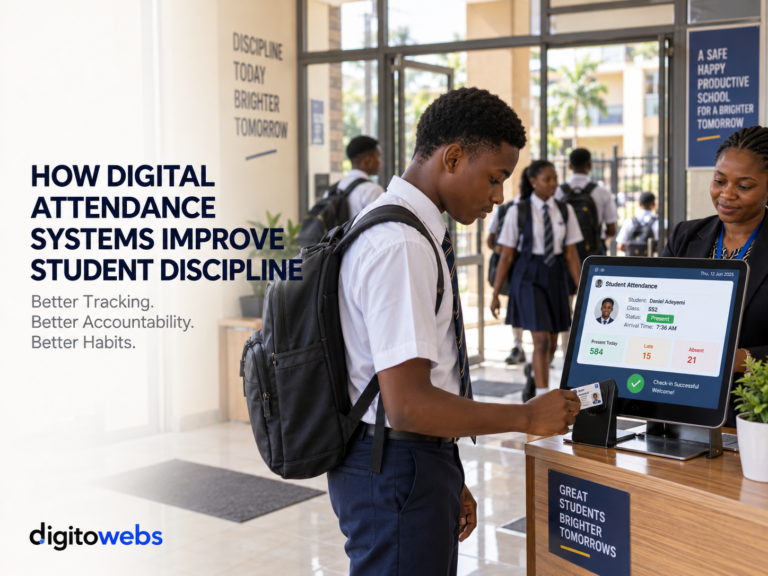
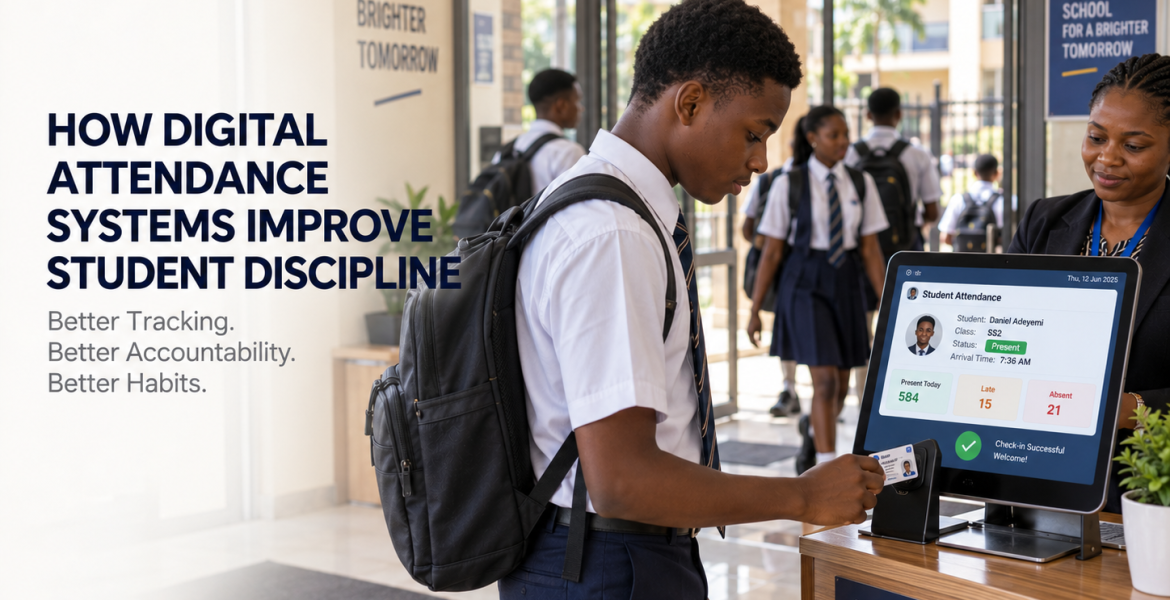
A digital dashboard can provide useful information such as:
Total Students: 620
Present Today: 584
Absent: 21
Late: 15
Attendance Rate: 94.2%
This allows management to quickly understand the day.
The system may also highlight students with repeated attendance issues.
For example:
Students Late More Than 3 Times This Month
That helps administrators know where intervention may be necessary.
Instead of waiting for a teacher to complain, management can act from the data.
How Parents Benefit From Digital Attendance Systems
Parents benefit most from clarity.
A parent may receive information about:
- Absence
- Late arrival
- Early departure
- Repeated attendance issues
- Attendance percentage
This gives families the opportunity to respond earlier.
A parent may discover that transport is consistently causing lateness.
Another may learn that a child is missing a particular class.
Another may realise the student is leaving home on time but not arriving at school on time.
These are very different problems.
Good attendance data helps identify which one is happening.
Different Types of Digital Attendance Systems
Schools have several options.
The best choice depends on size, budget, infrastructure and operational needs.
Teacher-Based Digital Attendance
Teachers mark attendance through a web or mobile interface.
This is often one of the simplest options.
It requires minimal additional hardware.
QR Code Attendance
Students or staff scan a QR code.
This can be convenient, but the system must prevent students from checking in for one another.
Student ID Card Systems
Students tap or scan an identification card.
This can make entry recording faster.
Cards can also serve other school functions depending on the system.
NFC Attendance Systems
NFC allows students to tap a compatible card or device against a reader.
This can create quick check-in experiences.
Biometric Attendance
Fingerprints, facial recognition or other biometric systems can be used in some environments.
Schools should carefully consider privacy, cost, reliability and legal responsibilities before collecting biometric information.
Technology should be proportional to the actual problem being solved.
A school does not necessarily need the most complicated option.
Why Real-Time Attendance Data Matters
Traditional attendance reports are often useful only after the fact.
At the end of the month, someone discovers:
“This student was absent seven times.”
That information is still valuable.
But earlier visibility would have been better.
Real-time or near-real-time attendance data can help schools act sooner.
Suppose a student suddenly stops attending regularly.
If management sees the pattern after two or three days, they can investigate.
If nobody notices until the end of the term, the problem may already be serious.
This is why attendance connects closely with broader student progress tracking.
Attendance and academic performance are not the same thing.
But both are important indicators.
A school that can see changes early has more opportunity to respond.
Attendance Systems and Student Privacy
Attendance data is student information.
Schools should treat it responsibly.
Not every staff member should have access to every student’s complete attendance history.
Access should depend on role.
A class teacher may need one level of access.
A principal may need another.
A parent should only see information connected to their own child.
Technology makes data easier to access.
That means schools must also become more careful about who can access it.
Permissions matter.
Passwords matter.
Data protection matters.
Good digital transformation combines convenience with responsibility.
The Cost of Poor Attendance Management
Schools often think about digital attendance in terms of software cost.
That is understandable.
But poor attendance management has its own cost.
Consider:
- Teachers spending time on manual registers
- Staff calculating attendance percentages by hand
- Parents discovering problems too late
- Repeated lateness becoming normal
- Students missing classes unnoticed
- Management lacking reliable records
- Disputes about attendance
- Paper registers becoming lost or damaged
These problems consume time.
They can also affect school culture.
When students believe lateness will not be noticed, punctuality becomes harder to enforce.
When parents feel the school cannot provide accurate attendance information, trust can suffer.
Doing nothing has a cost too.
Choosing the Right Attendance System for Your School
Do not choose a system because the demonstration looked impressive.
Choose one that fits your school.
Ask:
Can teachers use it quickly?
Does it work on mobile devices?
Can it handle different classes?
Can parents receive appropriate notifications?
Can management see attendance trends?
Can access be controlled?
Can records be corrected properly?
Can the system distinguish between absent and late?
Can it support early departure?
Can it grow with the school?
Who provides support?
The best system is not the one with the most features.
It is the one your school will use consistently.
Digital Attendance Should Connect With Other School Systems
Attendance becomes more useful when it is part of a wider school management environment.
The system already knows the student.
It knows the class.
It may contain academic results.
Assignments.
Timetables.
Student progress records.
Parent information.
Attendance should connect appropriately with that existing record.
This avoids duplication.
The school should not need to type the same student information into several unrelated systems.
A connected digital environment creates cleaner administration.
It can also provide a fuller picture of the student.
For example, repeated absence combined with falling academic performance may require a different response from repeated absence with stable performance.
Context matters.
Your School Website Is Also Part of the Digital Experience
Internal school systems help manage enrolled students.
Your public website has a different job.
It helps prospective parents understand your school.
Before a parent ever sees your attendance system, they may first see your website.
They search your school name.
Open the homepage.
Check facilities.
Review academics.
Read about admissions.
Look for contact information.
Maybe compare your school with three others.
That digital first impression matters.
A school can be modern internally but still look outdated publicly.
If your website is slow, difficult to use, poorly maintained or confusing on mobile phones, prospective parents may never get far enough to discover how good the school actually is.
Your public website and internal systems serve different purposes.
Together, they shape the overall digital experience.
Why Fully Managed Website Management Makes Sense for Schools
A website does not stop needing attention after launch.
Someone still has to manage:
- Domain
- Hosting
- Website updates
- Maintenance
- Technical problems
- Content changes
- Support
Many schools discover this after paying someone to build a website.
The site goes live.
Then the developer disappears.
Months later, something needs changing.
Now the school starts searching again.
DIGITO WEBS takes a different approach.
Our Fully Managed Website Plans are designed for organisations that want a professional website without carrying the ongoing technical burden alone.
Depending on your selected plan and agreed scope, this can include:
- Professional website design
- Domain
- Hosting
- Ongoing website management
- Technical support
This gives the school a clearer ongoing relationship rather than treating the website as a one-time project.
Your team focuses on education.
DIGITO WEBS manages the website.
Digital Attendance Systems Improve Student Discipline Through Consistency
Return to the student who arrives late several times in one week.
In a poorly organised system, nobody sees the full pattern.
One teacher notices Monday.
Another sees Wednesday.
Friday goes unrecorded.
Nothing happens.
With digital attendance, the pattern is visible.
Management can respond.
Parents can be informed where appropriate.
The student understands that punctuality is being taken seriously.
That is the real value.
Digital attendance systems improve student discipline because they help schools become more consistent.
They improve visibility.
They strengthen accountability.
They help identify patterns earlier.
They support fairer decisions.
They improve communication with parents.
Most importantly, they help schools build a culture where attendance and punctuality are treated as normal parts of student responsibility.
Technology does not create discipline by itself.
But good systems make good discipline easier to manage.
Frequently Asked Questions About Digital Attendance Systems
What is a digital attendance system?
A digital attendance system is a technology-based method of recording student presence, absence, lateness and, in some cases, arrival or departure time.
How do digital attendance systems improve student discipline?
They improve discipline by making attendance records more consistent, helping schools identify repeated lateness or absence and giving students clearer accountability.
Can parents receive attendance notifications?
Yes. Depending on the school’s system and policies, parents can receive notifications when their child is absent, late or leaves school early.
Can digital attendance reduce lateness?
It can help. Students may become more punctual when attendance and arrival times are consistently recorded and schools act on repeated patterns.
Are digital attendance systems suitable for small schools?
Yes. A simple teacher-based digital attendance system can work well even for smaller schools.
Do schools need biometric attendance systems?
Not necessarily. Schools should choose technology based on actual needs. Teacher portals, ID cards, QR codes or NFC systems may be sufficient depending on the environment.
Can attendance data be connected to student records?
Yes. In an integrated school management system, attendance can form part of the student’s wider record.
Is student attendance information private?
Yes. Attendance data should be protected and made available only to authorised users.
Can digital attendance work on mobile phones?
Yes. Mobile-friendly access is particularly important for schools in Nigeria because teachers, parents and administrators may rely heavily on smartphones.
How much does a school website cost in Nigeria?
The cost depends on the size, features, integrations and level of ongoing management required. Schools should consider not only the initial website price but also domain, hosting, maintenance, website management and technical support.
Build a Better Digital Presence for Your School With DIGITO WEBS
Modern schools are becoming more organised digitally.
Attendance is becoming easier to track.
Results are becoming easier to process.
Assignments can be managed online.
Parents can access important information more conveniently.
But your public website matters just as much.
It is often where prospective parents form their first impression of your school.
If your website looks outdated, works poorly on mobile devices, is rarely updated or depends on finding a different developer whenever something goes wrong, your school is carrying an unnecessary burden.
DIGITO WEBS provides Fully Managed Website Plans for schools, businesses and organisations in Nigeria that want a professional online presence with ongoing support.
Depending on your selected plan and agreed scope, we help manage key areas such as:
- Professional website design
- Domain
- Hosting
- Ongoing website management
- Technical support
This means your school can focus on students, teachers, parents and education.
DIGITO WEBS focuses on keeping your website professionally managed.
Ready to improve your school’s online presence?
Get Started: Choose a DIGITO WEBS Fully Managed Website Plan.
Call or WhatsApp: +234 706 771 9042
Email: support@digitowebs.com
Website: www.digitowebs.com
CTA: Get Started | Choose a Plan | Book a Call