Technology simplifies examination management by reducing the amount of repetitive work schools must perform before, during and after examinations.
Consider what examination season can look like in a busy school.
Teachers are submitting questions.
Administrators are preparing timetables.
Students are checking examination dates.
Scores are being recorded.
Scripts are being marked.
Results are being calculated.
Report cards need to be prepared.
Parents are waiting.
Management wants everything completed before the end of the term.
Now imagine that the school has hundreds or even thousands of students.
A small mistake suddenly becomes a big problem.
One score is entered incorrectly.
A subject is missing from a result sheet.
Someone calculates an average wrongly.
A report card has to be printed again.
A parent notices the mistake.
The school starts checking several spreadsheets, notebooks and paper records to find out what happened.
This is one reason modern schools are increasingly using technology to organise examination processes.
Technology does not remove teachers from assessment.
It does not make academic judgement unnecessary.
What it can do is reduce avoidable administrative work and make examination management more organised.
Table of Contents
ToggleWhat Is Examination Management?
Examination management refers to the different activities involved in planning, conducting, recording and processing student assessments.
It can include:
- Examination scheduling
- Subject allocation
- Question preparation
- Candidate records
- Continuous assessment
- Examination scores
- Grade calculation
- Result processing
- Report card generation
- Result approval
- Result publication
- Academic record keeping
In a small school, some of these activities may be manageable manually.
As the school grows, the process becomes more complicated.
There are more students.
More subjects.
More teachers.
More classes.
More results.
More opportunities for errors.
That is where technology becomes useful.
Why Examination Management Becomes Difficult as Schools Grow
Imagine a school with 80 students.
A few spreadsheets may be enough.
Now imagine the same school grows to 800 students.
The same manual process becomes much harder to manage.
Ten teachers may be entering scores.
Different classes may have different subjects.
Some students may be absent for certain assessments.
Some scores may need corrections.
Some classes may use different grading structures.
Management still expects accurate results.
Parents expect reports on time.
This means examination management is not only about marking scripts.
It is also about managing information.
And information becomes harder to manage when it is scattered.
A proper system brings structure to that information.
7 Ways Technology Simplifies Examination Management
1. Examination Scores Can Be Recorded More Efficiently
One of the most repetitive examination tasks is score entry.
Without a connected system, a teacher may record scores in a notebook.
Then transfer them into a spreadsheet.
Someone else may copy them into another master sheet.
Eventually, the same information may be entered several times.
Every extra step creates another opportunity for error.
A digital examination management system can reduce this duplication.
Teachers can enter authorised scores directly into the appropriate class and subject records.
This creates one source of information instead of several conflicting copies.
It also makes corrections easier to track.
The objective is simple.
Enter the correct information once and use it properly.
2. Grade Calculations Can Be Automated
Manual calculations can become stressful when hundreds of student results are involved.
Consider a grading structure such as:
Continuous Assessment: 40%
Examination: 60%
Total: 100%
The school may also need to calculate:
- Total score
- Percentage
- Grade
- Position
- Class average
- Subject average
- Overall performance
Humans can calculate these things.
The problem is scale.
The more calculations people perform manually, the more opportunities there are for mistakes.
Technology can automate agreed calculation rules.
Once the school defines how results should be calculated, the system can apply those rules consistently.
This can save time and reduce arithmetic errors.
3. Examination Timetables Become Easier to Organise
Timetables may look simple after they have been completed.
Creating them is often another story.
Different classes take different subjects.
Some teachers may supervise several examinations.
Rooms may need to be allocated.
Certain subjects may require more time.
Conflicts must be avoided.
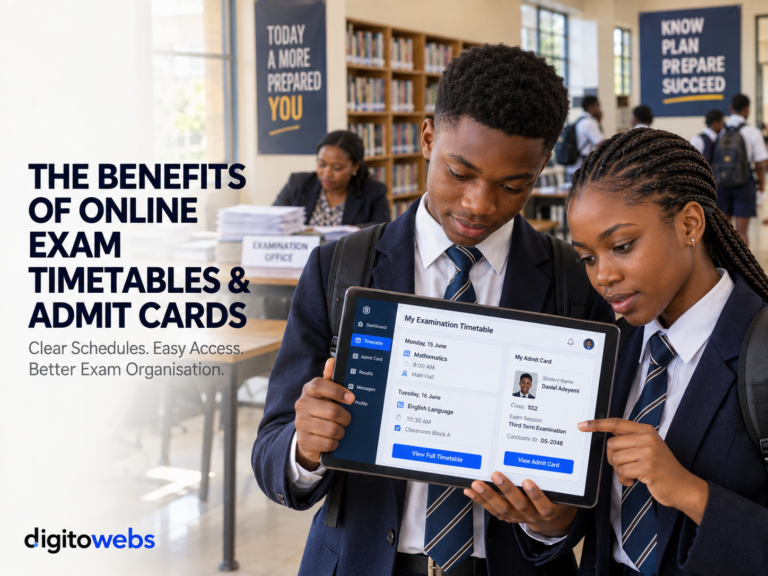
A digital system can help administrators organise examination schedules more clearly.
Students and parents may also be able to access the approved timetable digitally.
That reduces dependence on printed copies that can be misplaced.
When changes are necessary, updated information can be communicated more efficiently.
4. Result Processing Can Become Faster
The period between the final examination and result publication is often stressful.
Teachers are marking.
Scores are being entered.
Errors are being checked.
Grades are being calculated.
Report cards are being prepared.
Management is reviewing everything.
Parents are asking:
“When will the results be ready?”
This is one of the clearest examples of how technology simplifies examination management.
Once scores are properly entered, many downstream processes can be automated.
The system can calculate totals.
Apply grading rules.
Generate summaries.
Prepare report cards.
Provide authorised staff with records for review.
Instead of rebuilding the result from several sources, much of the information is already connected.
That can shorten the time between assessment and result publication.
5. Errors Become Easier to Detect and Correct
No school can promise that nobody will ever make a mistake.
The important question is how quickly mistakes can be identified and corrected.
Suppose a teacher accidentally enters 18 instead of 81.
In a manual environment, that error may move through several documents before someone notices.
A digital system can create validation rules.
For example, if an examination is scored over 70, the system should not accept 81.
If a score is missing, the system may flag it.
If a subject has not been completed for a class, administrators can see it.
These controls do not replace human review.
They support it.
Technology can help schools catch mistakes before they reach parents.
6. Results Can Be Stored More Organisedly
Examination results become part of a student’s academic history.
That information may be needed later.
A parent may request an old report.
A student may transfer to another school.
Management may want to compare performance across terms.
Teachers may need to understand a student’s previous academic record.
If results exist only as printed sheets, retrieving them can take time.
If they are scattered across staff laptops and different spreadsheets, the problem becomes worse.
A properly designed system can maintain organised academic records.
Authorised users can retrieve information more easily.
This makes examination data more useful beyond the term in which it was created.
7. Students and Parents Can Access Results More Conveniently
Parents should not necessarily need to visit the school office simply to collect information that can safely be provided digitally.
Where appropriate, schools can publish approved results through secure student or parent portals.
A parent signs in.
Selects the child.
Views the approved result.
The student can also review performance.
This can create a better experience, especially for busy families.
It also reduces unnecessary pressure on administrative staff.
But access must be controlled.
Results are sensitive school records.
They should only be available to authorised users.
Convenience should never come at the expense of privacy.
How Technology Helps Teachers During Examination Periods
Examination season can add significant administrative pressure to teachers.
They already need to teach, assess, mark and provide feedback.
The software should not make that harder.
A good system can help teachers organise:
- Continuous assessment scores
- Examination scores
- Missing scores
- Subject records
- Grade information
- Comments
- Student performance
It should also make the workflow simple.
The teacher selects the class.
Selects the subject.
Enters or reviews scores.
Saves the record.
The process should be understandable without complicated technical knowledge.
If teachers find the system difficult, they may start keeping unofficial spreadsheets as a backup.
Soon, the school has multiple versions of the same information again.
Usability matters.
How Technology Helps Examination Officers
The examination officer often carries a large part of the administrative burden.
They may need to coordinate:
- Timetables
- Subject records
- Teacher submissions
- Missing scores
- Result completion
- Corrections
- Approval
- Report generation
Technology can provide a clearer overview.
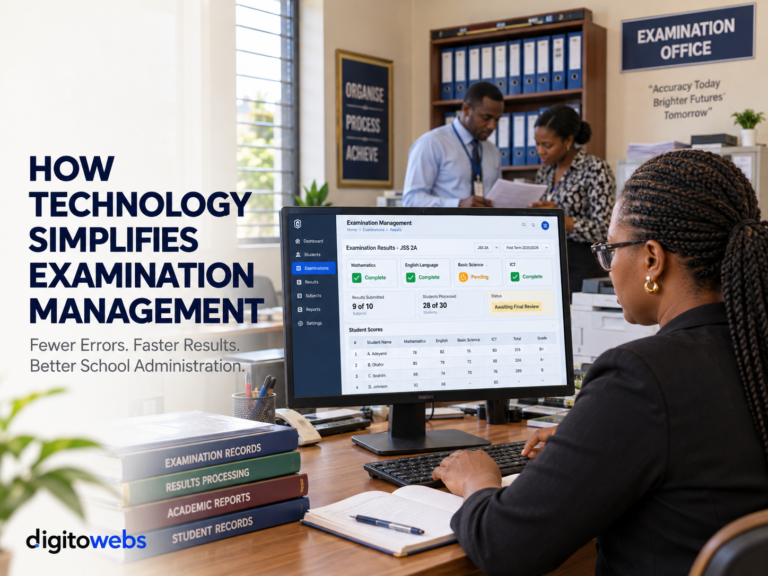
Instead of calling every teacher to ask whether scores have been submitted, the officer may be able to see completion status from the dashboard.
For example:
- JSS1 Mathematics: Complete
- JSS1 English Language: Complete
- JSS1 Basic Science: Pending
- JSS1 ICT: Complete
That small improvement can save significant time.
The officer knows where attention is needed.
Technology Can Improve Result Processing
Result processing is one of the areas where schools often feel the difference between manual and digital systems most strongly.
A connected system can combine assessment information using the school’s approved grading rules.
For example:
Continuous Assessment: 32/40
Examination: 48/60
Total: 80/100
Grade: A
The system can perform the calculation automatically.
It can then present the information inside the student’s result.
This reduces repeated manual calculations.
It also improves consistency.
If the grading rule says 70 to 100 is Grade A, the system applies that same rule to every authorised result.
There is less room for one teacher interpreting the grading structure differently from another.
How Examination Technology Helps Parents and Students
Results should tell a story.
A parent does not only need to see:
Mathematics: 62%
It can be more useful to understand whether the student is improving.
For example:
Term 1: 48%
Term 2: 56%
Term 3: 62%
Now there is context.
The student is progressing.
This can encourage better conversations between parents, students and teachers.
The same applies when performance is declining.
Digital academic records can help schools spot patterns earlier.
That connects examination management with broader student progress tracking.
The examination result becomes part of an ongoing picture, rather than an isolated document produced three times a year.
Why Data Accuracy Matters
One wrong examination result can create a surprisingly large problem.
Imagine a parent opening a report card and seeing a score that is clearly incorrect.
Even if the mistake is eventually fixed, something has changed.
Trust.
The parent begins wondering:
“If this score is wrong, what else is wrong?”
Schools therefore need strong processes around academic records.
Technology can help, but only when properly configured.
The system should support:
- Validation
- Permissions
- Review processes
- Approval workflows
- Audit records
- Controlled corrections
Not every staff member should be able to change every result.
Different users should have different levels of access.
A teacher may enter scores.
A senior academic officer may review them.
Management may approve publication.
This kind of structure protects both the school and the student.
The Cost of Manual Examination Management
Schools often focus on the cost of buying technology.
They should also calculate the cost of operating inefficiently.
Consider how many staff hours are spent every term on:
- Recalculating scores
- Correcting spreadsheets
- Looking for missing records
- Preparing report cards manually
- Reprinting reports
- Chasing teachers for submissions
- Answering repeated result enquiries
- Searching for old student records
Each task may appear small.
Combined across hundreds of students and multiple terms, they can become significant.
There is also the hidden cost of errors.
A mistake on a student’s result can damage parent confidence.
A delayed result can create frustration.
A lost academic record can become a serious administrative problem.
Doing nothing may feel cheaper because there is no software invoice.
That does not mean it is free.
Choosing the Wrong Examination System Can Also Be Expensive
Technology is not automatically good simply because it is digital.
Schools should avoid purchasing examination software based only on impressive screenshots.
Ask practical questions.
Can our teachers use it?
Can our examination officer understand it?
Does it support our grading structure?
Can it handle continuous assessment?
Can corrections be controlled?
Does it maintain proper records?
Can results be reviewed before publication?
Does it work well on mobile devices?
Can parents access only their own children’s information?
Can it grow with the school?
Who provides support?
A system that looks beautiful but creates confusion is not an improvement.
The goal is operational simplicity.
Examination Management Should Connect With Other School Systems
Examination management should not exist alone.
Academic results are connected to other information.
The system already knows the student.
It knows the class.
It knows the subjects.
It may know attendance.
It may contain assignments.
It may contain previous results.
This is why integrated school systems can be more useful than disconnected tools.
Imagine entering student names separately into:
One result software.
One attendance software.
One assignment platform.
One parent communication tool.
That creates duplication.
A better digital structure allows information to move appropriately across related modules.
The student record becomes the foundation.
Your School Website Is Also Part of the Digital Experience
Examination systems primarily serve existing students, parents and staff.
Your school website serves another important audience.
Prospective parents.
Before someone sees your result portal, they may first visit your website.
They search for your school online.
They open the homepage.
They want to understand:
Who are you?
What do you teach?
What makes your school different?
What facilities do you have?
How does admission work?
How can I contact you?
A school may have excellent internal technology and still create a poor first impression with an outdated website.
That is why schools should think about their digital experience as a whole.
The public website introduces the school.
Secure internal systems support enrolled families.
Both should feel professional and organised.
A Fully Managed Website Removes Another Technical Burden
Schools already manage academics, teachers, parents, facilities, admissions, finance and students.
Website technical management should not become another daily distraction.
After a website is designed, there are still responsibilities.
The domain needs management.
Hosting needs attention.
Content needs updating.
Technical issues may arise.
Software may need maintenance.
Support may be required.
This is why DIGITO WEBS provides Fully Managed Website Plans.
Instead of giving your school a website and disappearing after launch, the website can be managed as an ongoing service.
Depending on your selected plan and agreed scope, your school can receive:
- Professional website design
- Domain
- Hosting
- Ongoing website management
- Technical support
This approach helps schools understand the real cost of maintaining a professional online presence.
It also removes the need to find a different developer every time something goes wrong.
Your team focuses on running the school.
DIGITO WEBS manages the website.
Technology Simplifies Examination Management by Removing Repetitive Work
Return to our examination officer.
Hundreds of results are waiting.
Teachers are submitting scores.
Parents are expecting report cards.
Management wants everything completed quickly.
In the old process, the officer may spend days moving information between documents and checking calculations.
In a connected system, much of that repetitive work can be reduced.
Scores are entered in the right place.
Calculations follow defined rules.
Missing records can be identified.
Results can be reviewed.
Approved reports can be generated.
Parents can receive authorised access.
That is the practical reason technology simplifies examination management.
It does not remove the importance of teachers.
It does not replace academic judgement.
It removes unnecessary administrative friction around the work teachers and administrators already need to do.
And when that happens, schools can spend less time managing spreadsheets and more time focusing on education.
Frequently Asked Questions About Examination Management Technology
What is an examination management system?
An examination management system is a digital platform that helps schools organise examination-related activities such as score entry, grading, result processing, report generation and academic record management.
How does technology simplify examination management?
Technology can reduce repetitive data entry, automate calculations, identify missing information, organise academic records and make approved results easier to distribute securely.
Can examination software calculate grades automatically?
Yes. A properly configured system can apply the school’s approved grading rules automatically after scores are entered.
Can teachers enter results directly?
Yes, depending on the system and the school’s permissions. Teachers may be authorised to enter scores for their assigned classes and subjects.
Can parents check examination results online?
Yes. Schools can provide secure parent portal access after results have been reviewed and approved.
Is examination management software useful for small schools?
Yes. Small schools can benefit from organised records and automated calculations, especially if they expect student numbers to grow.
Can technology completely eliminate examination errors?
No. Human mistakes can still occur. Technology can reduce certain errors and make them easier to detect, but schools still need good review and approval processes.
Should every staff member be able to edit results?
No. Academic systems should use role-based permissions so that users can only perform actions appropriate to their responsibilities.
Can examination records be stored for future reference?
Yes. One of the major benefits of digital examination management is the ability to maintain organised academic history for authorised retrieval.
How much does a school website cost in Nigeria?
School website pricing depends on the number of pages, features, integrations and level of ongoing management. Schools should also consider domain, hosting, maintenance, website management and technical support.
Give Your School a Better Digital Presence With DIGITO WEBS
Technology can help make examination management easier.
But your school’s digital transformation should not stop inside the administrative office.
Parents and prospective families are also judging your school online.
Your website should communicate the quality, professionalism and organisation they can expect from your school.
If your school website is outdated, difficult to use on mobile devices, rarely updated or dependent on finding a random developer whenever something goes wrong, that is already costing you.
You may be losing enquiries.
You may be creating the wrong first impression.
You may also be spending unnecessary time managing technical problems.
DIGITO WEBS provides Fully Managed Website Plans for businesses, schools and organisations in Nigeria that want a professional website without taking on the ongoing technical burden.
Depending on your selected plan and agreed scope, we help manage the essentials around your website, including:
- Professional website design
- Domain
- Hosting
- Ongoing website management
- Technical support
Instead of simply paying for a website once, you get an ongoing professional relationship designed to keep your online presence properly managed.
Ready to improve your school’s online presence?
Get Started: Choose a DIGITO WEBS Fully Managed Website Plan.
Call or WhatsApp: +234 706 771 9042
Email: support@digitowebs.com
Website: www.digitowebs.com
CTA: Get Started | Choose a Plan | Book a Call